
By Leah Diprose, Commercial Director | Data Hive Consulting · 19 November 2026
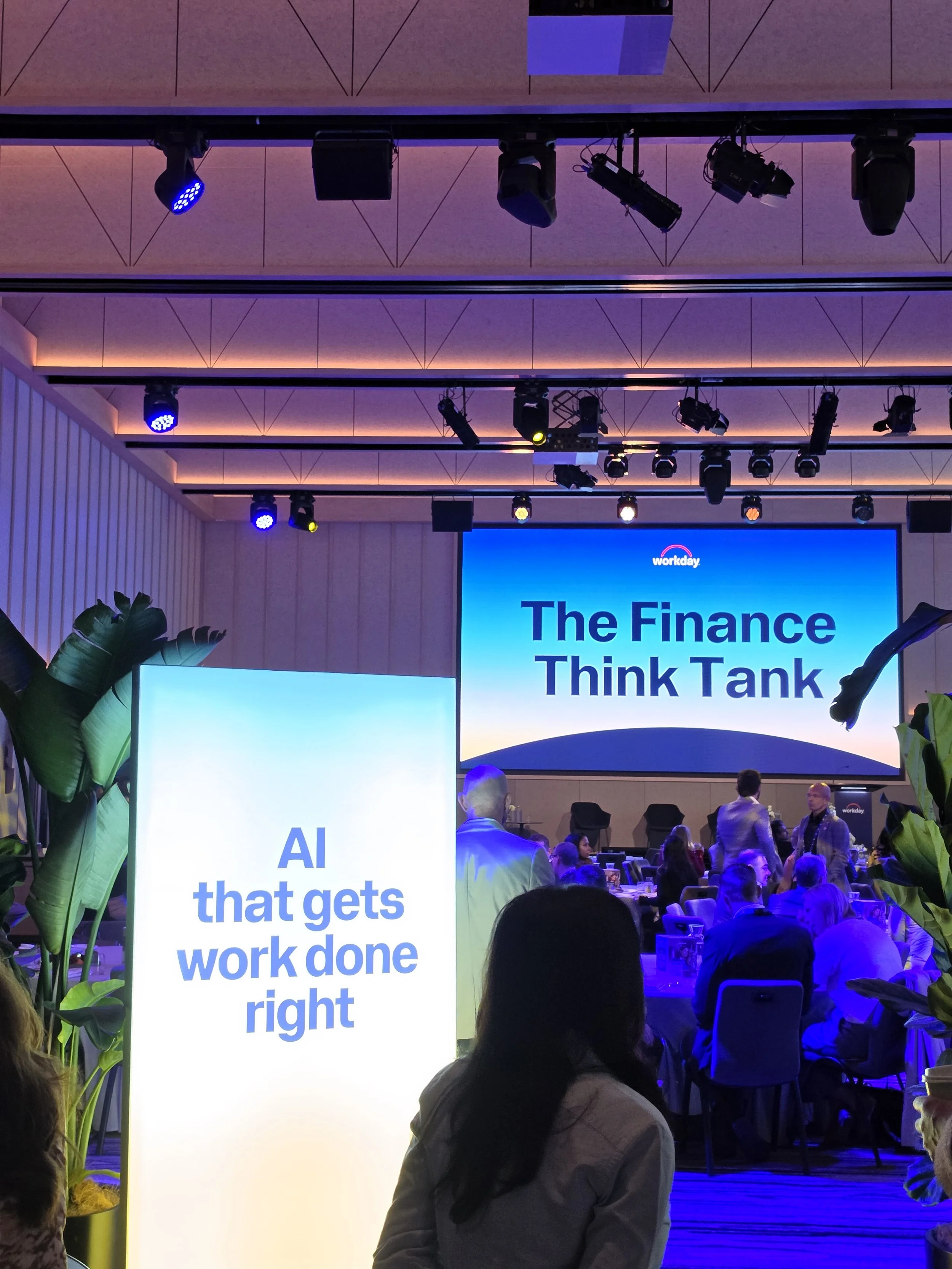
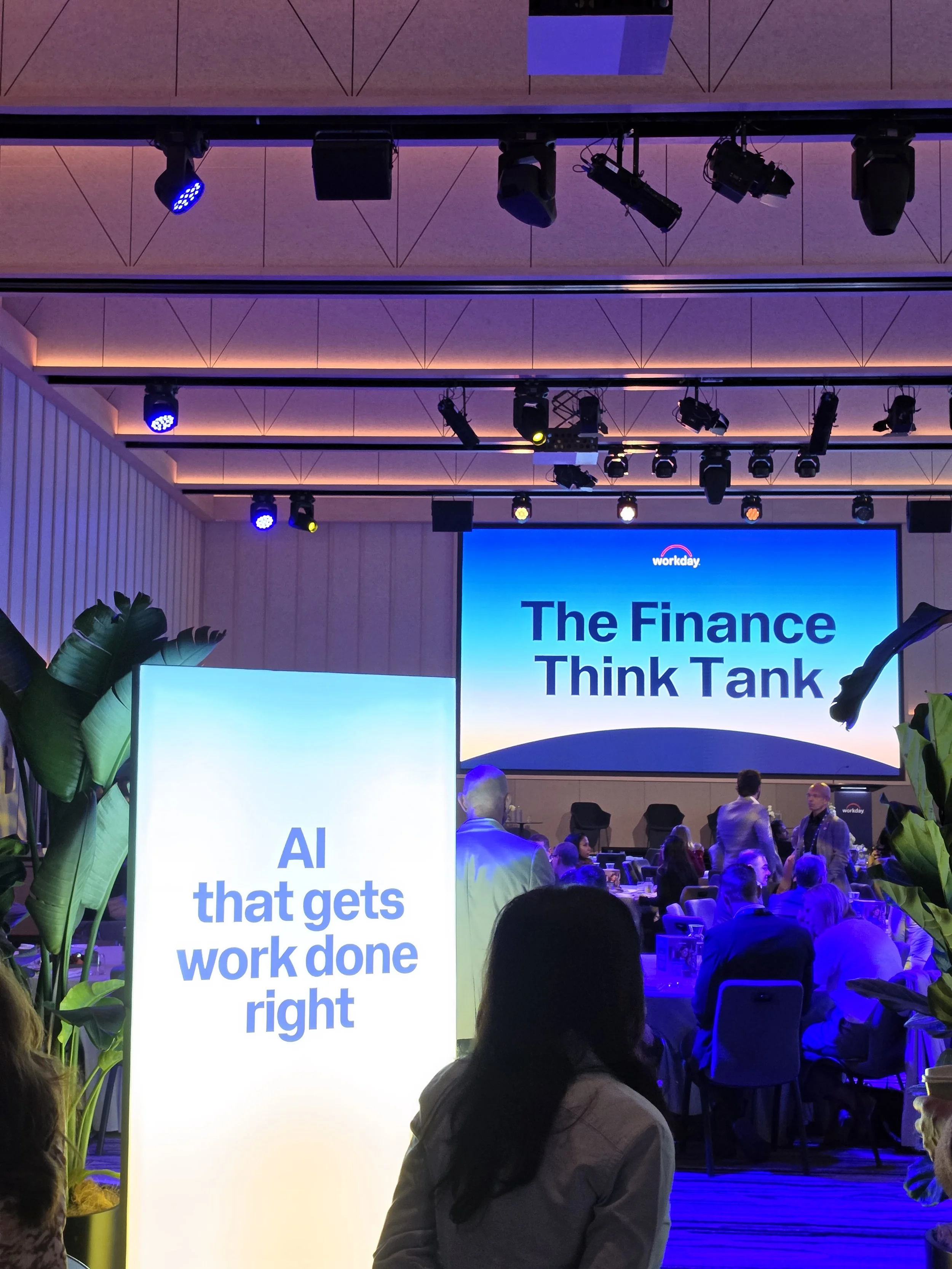
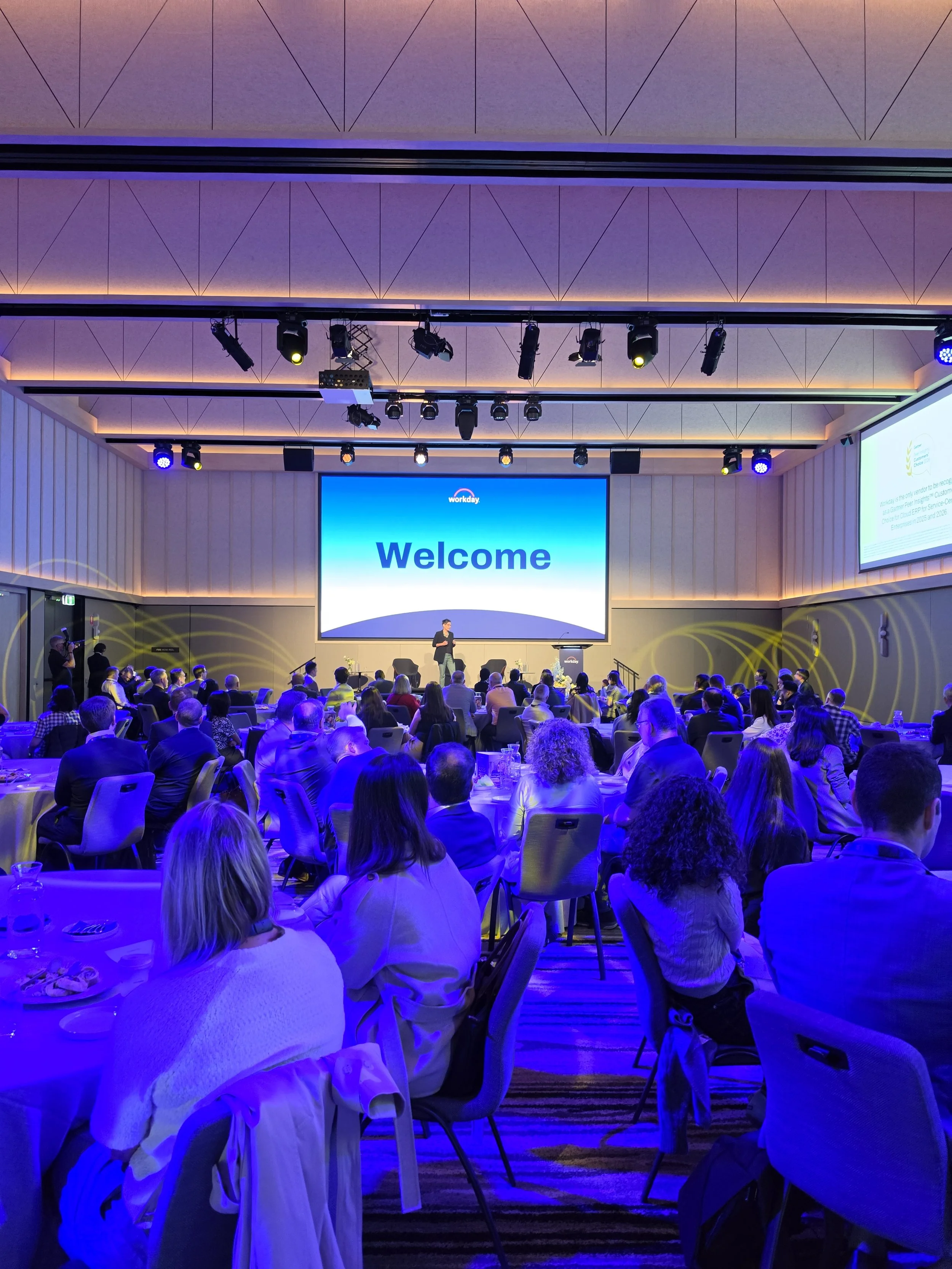
On Wednesday 18 November 2026, over 160 finance leaders attended Workday’s ‘The Finance Think Tank’ in Melbourne to hear the latest research and insights into what’s possible today with AI in finance.
Data Hive Consulting was there as part of the Adaptive partner network. This is what we heard. If you have any questions that arise from this blog, reach out to us via the details at the end of this post.
Executive summary
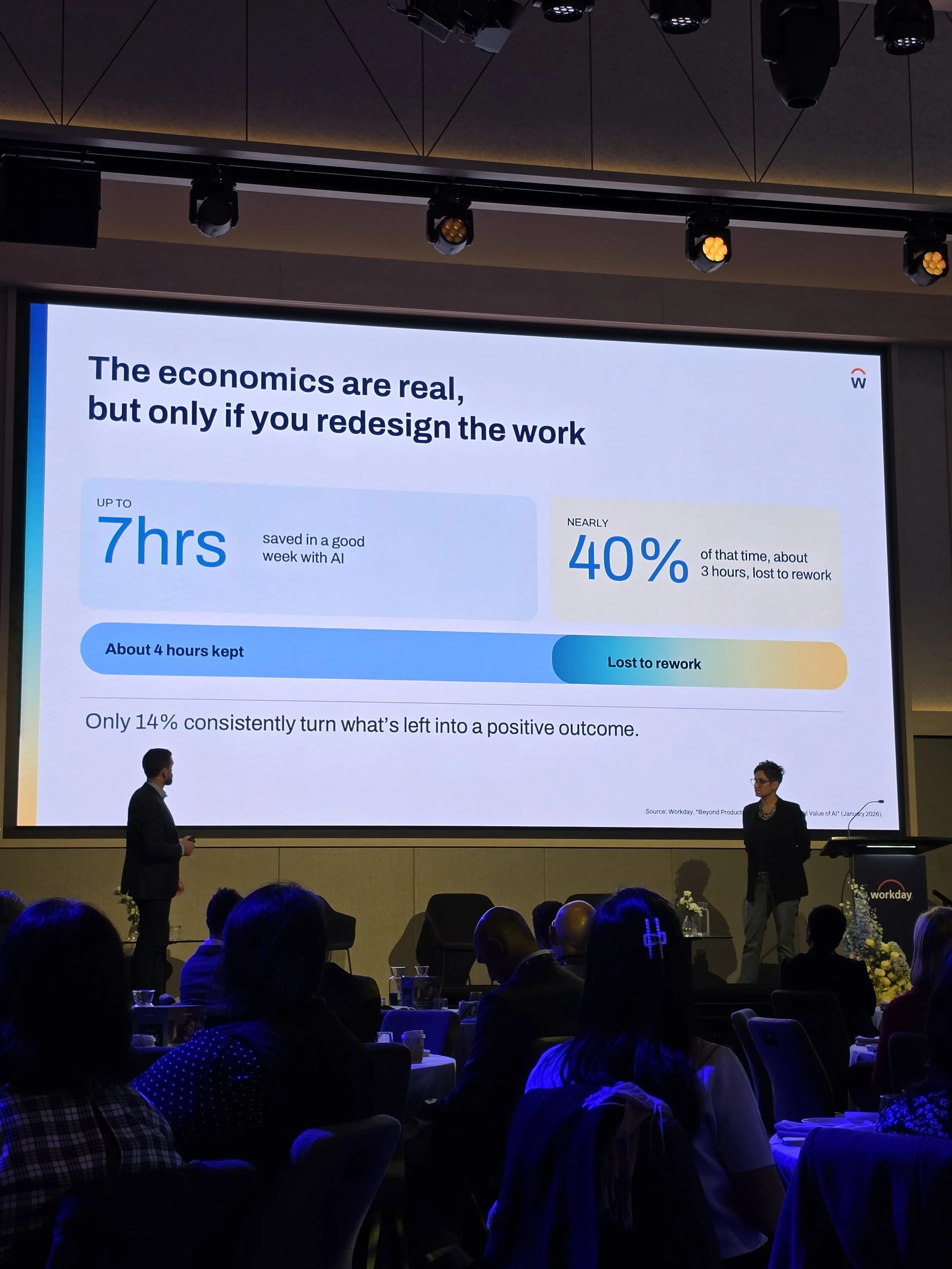
Finance teams are moving from AI experiments into everyday use, but the returns aren't automatic. Local research from ADAPT shows most CFOs are tracking AI adoption, not business value. Workday's own research found that up to 40% of the time AI saves is lost to checking and rework. Every speaker came back to the same point: AI is only as good as the data, controls, and judgement around it.
For FP&A, that makes the planning model the foundation that is critical for AI success and reducing rework. MYOB and Tennis Australia showed the payoff of getting the core right before layering on AI.
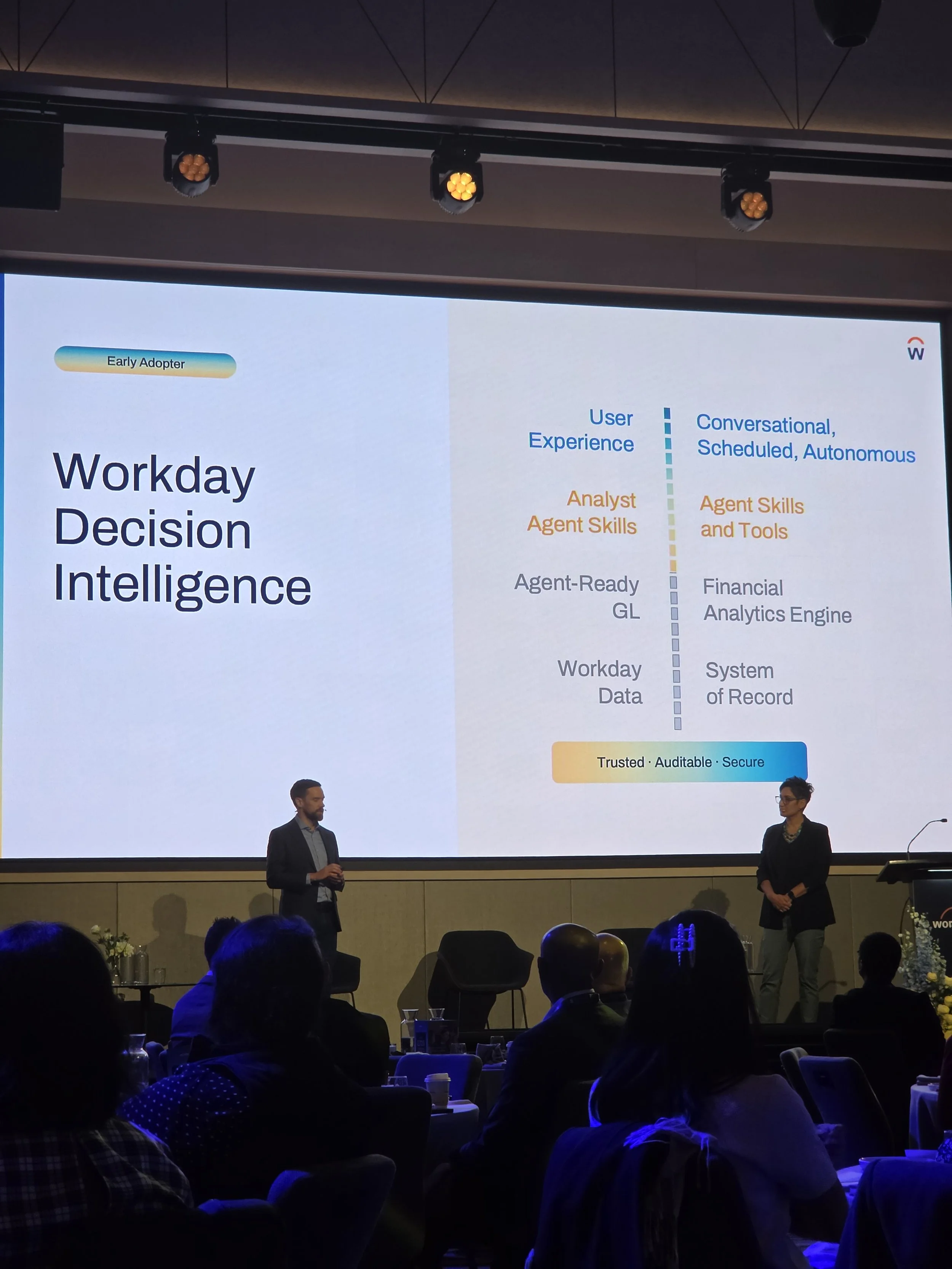
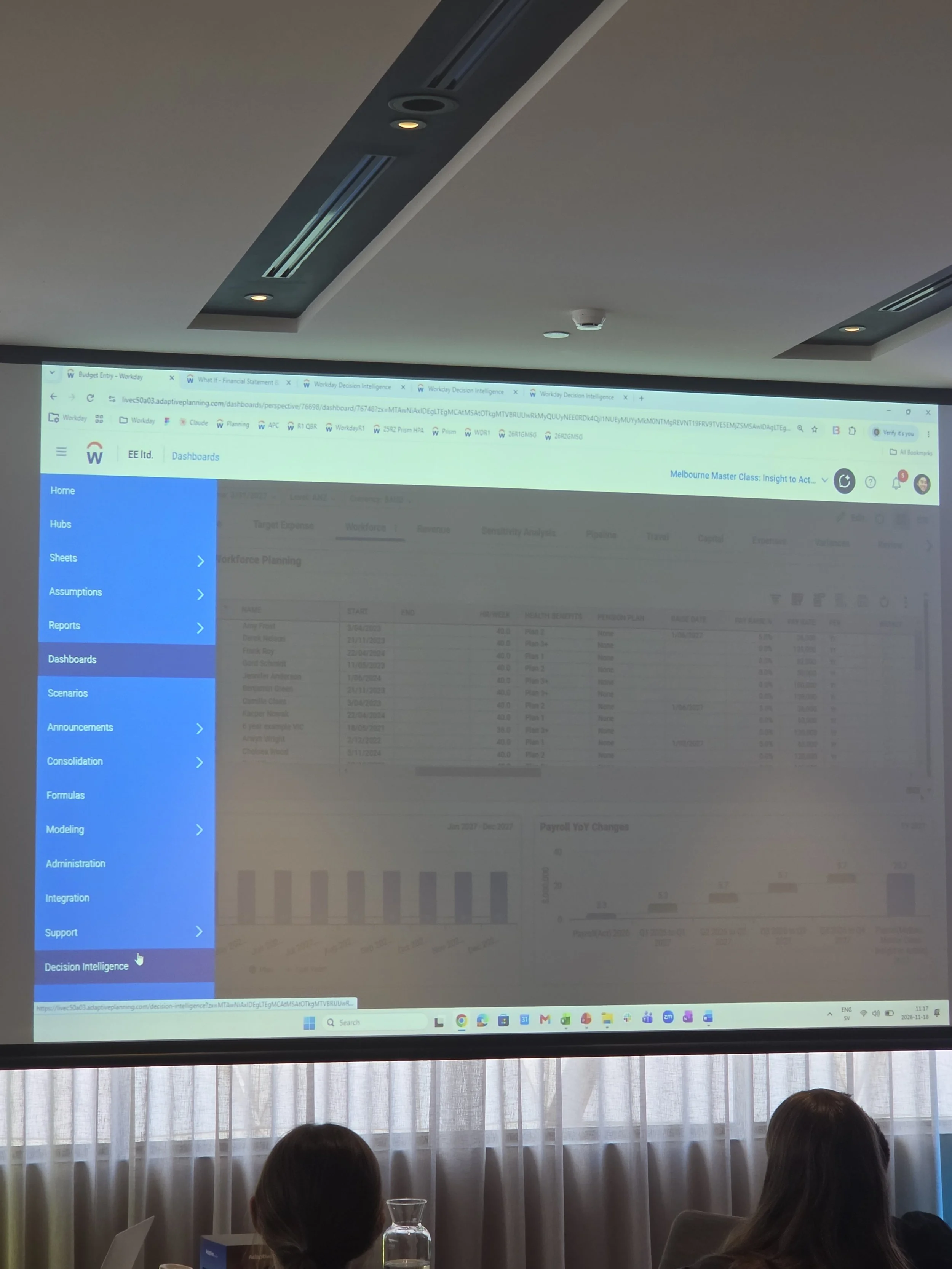
Workday's Decision Intelligence demo with Adaptive from Workday for FP&A showed what comes next: plain-English scenario modelling, risk analysis and decisions published straight back into Adaptive Planning, all on governed data.
If your reporting and planning still lives in disconnected spreadsheets (relying on people to copy and paste data from various systems), the FY28 budget cycle is the time to fix the foundations, and the solution can deliver ROI rapidly, with minimal team disruption.
The CFO's four AI questions
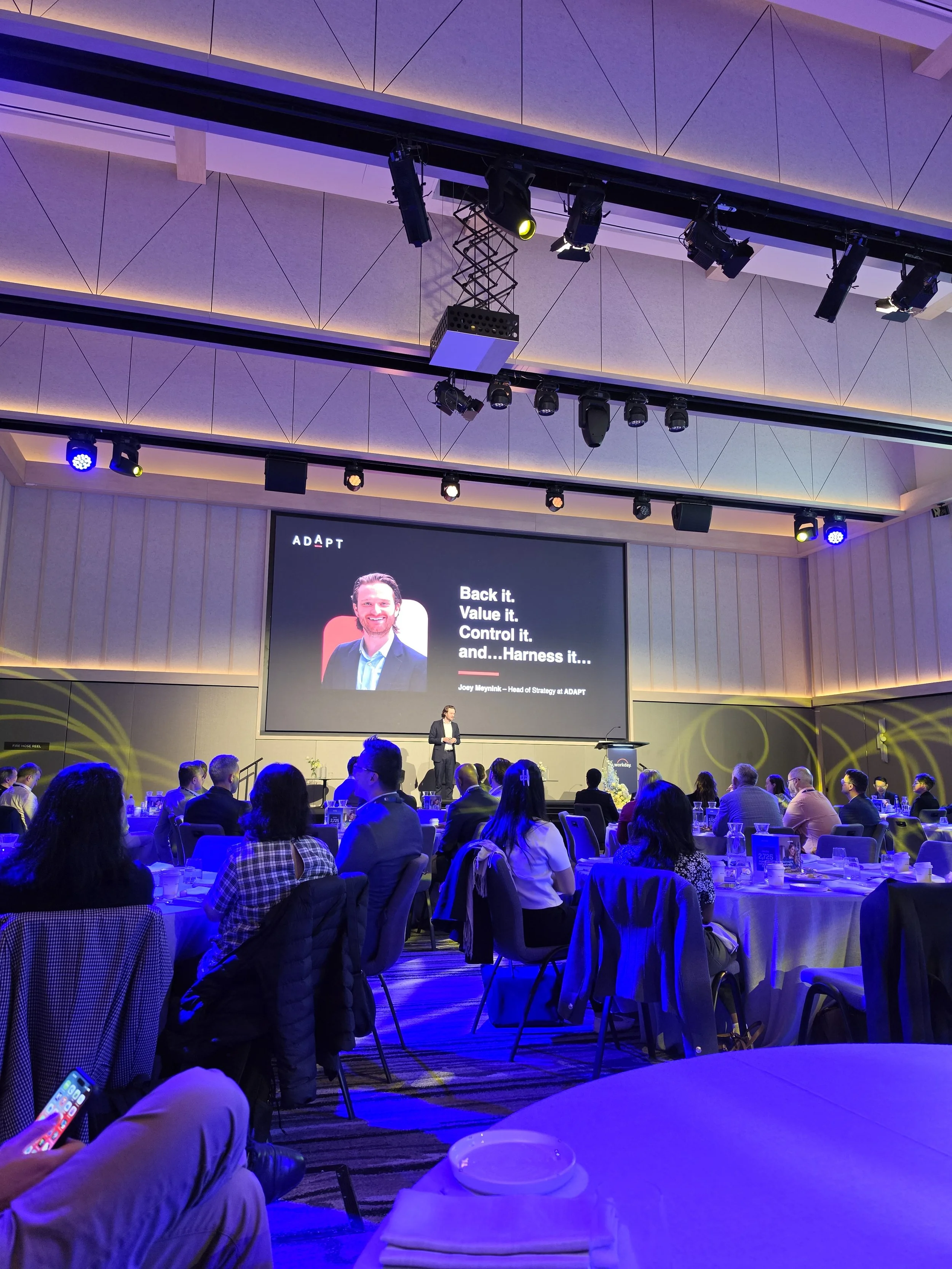
Every executive group is investing in AI, and nearly every one says lack of funding is its biggest barrier. That was the opening finding from Joey Meinig of ADAPT, drawing on 140+ CFOs at ADAPT's CFO Edge in Sydney the day before and a survey of around 1,000 Australian executives.
ADAPT's point: it's not just a funding problem. CFOs are asking four harder questions.
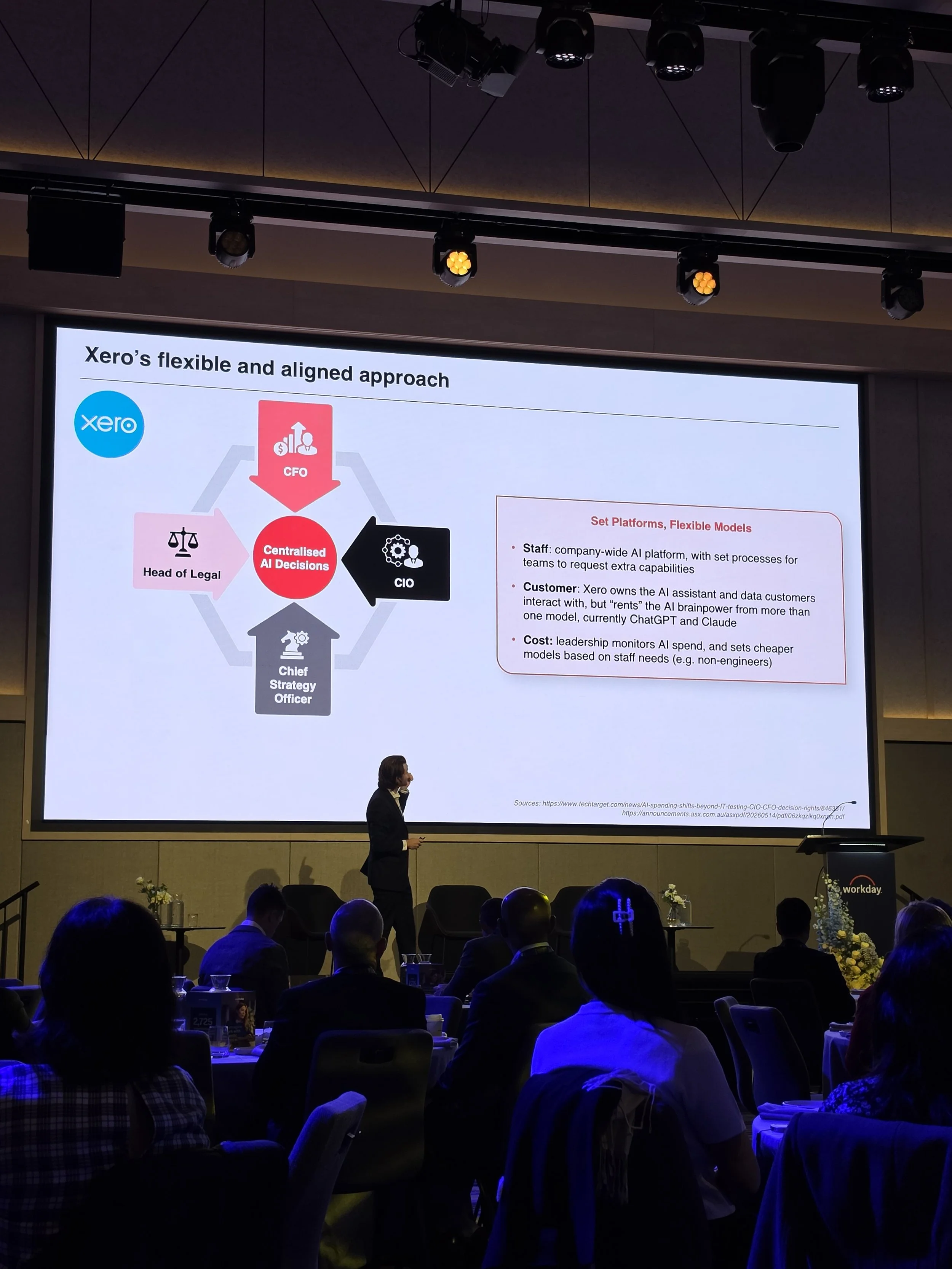
1. Back it: how do I make defensible investment calls? Only 1% of CIOs measure AI value org-wide with the CFO, 29% of CFOs have an integrated CIO partnership, and only about a third have full visibility of AI spend. Xero shows what good looks like: a joint AI decision hub (CFO, CIO, strategy and legal), standard platforms for staff, and the flexibility to swap AI models as the market moves.
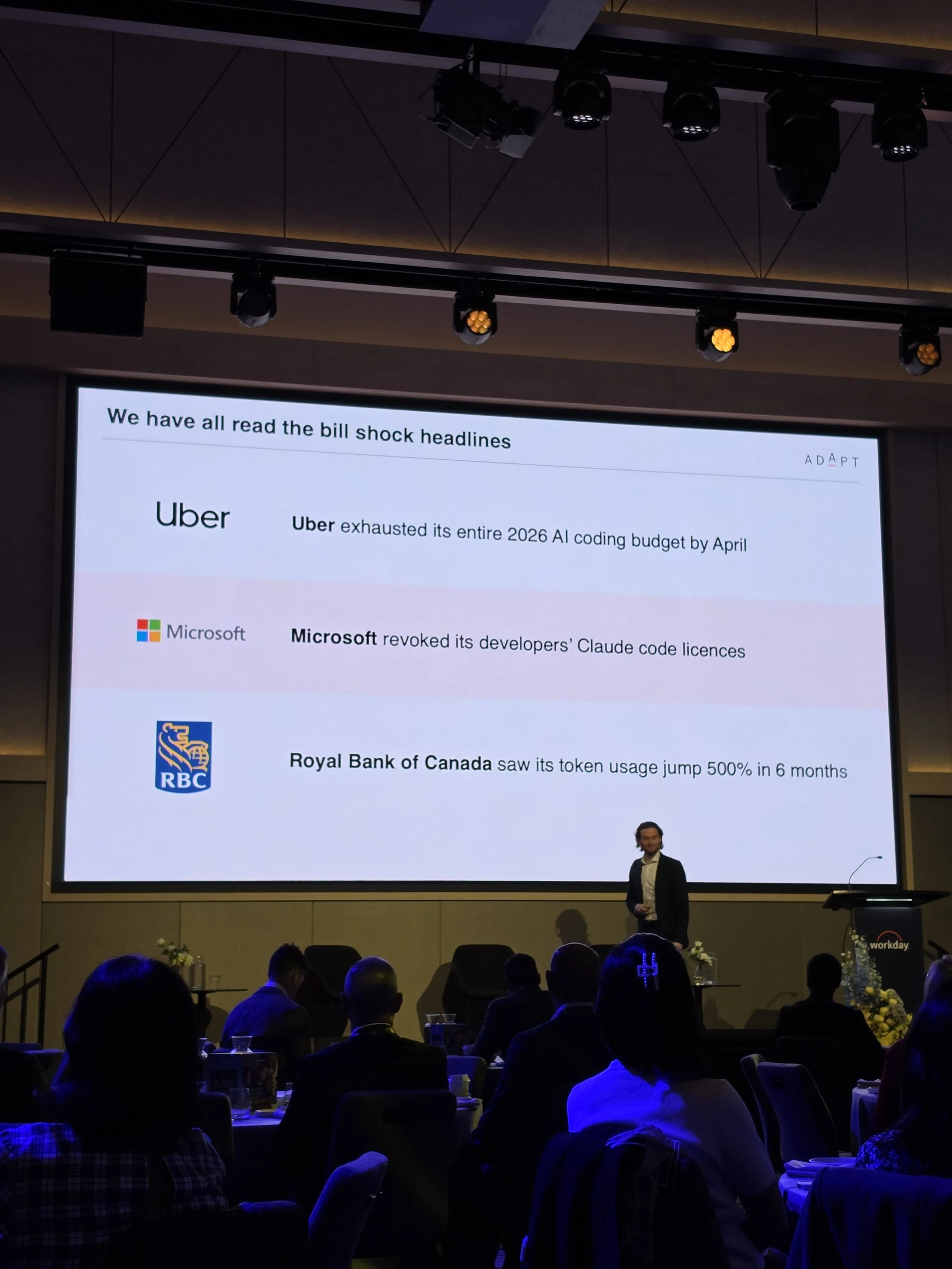
2. Value it: what's the true cost and return? Half of CFOs measure AI adoption, not the business value it creates. ADAPT's advice is to treat AI as a business asset, not software, and track cost per successful outcome, per task and per token.
3. Control it: who owns the risk? 94% of CISOs say they aren't ready to govern AI agents, and 11% of CFOs aren't sure who owns AI governance. CBA treats AI as a material risk, with a board-set risk appetite, a dedicated AI risk committee and an off switch.
4. Harness it: how does AI differentiate us? AI adoption is outpacing leadership maturity. Telstra ties 5% of leadership bonuses to its AI initiatives, and launched its Ask Telstra agent in six weeks.
The story that stuck with the room was an Australian bank's customer-service agent. A task costing a human about 8 cents per successful outcome came in at $1.40 for the agent once multi-agent costs ballooned. A $16,000 pilot became a $280,000 surprise in production.
Our take: you can't value what you can't model. The bank's $280k surprise was a planning failure as much as a technology one. In a driver-based planning tool like Adaptive Planning, AI costs such as cost per outcome or token volumes become drivers you can stress-test before a pilot goes into production. Otherwise you discover them in the actuals.
Procedures make AI trustworthy
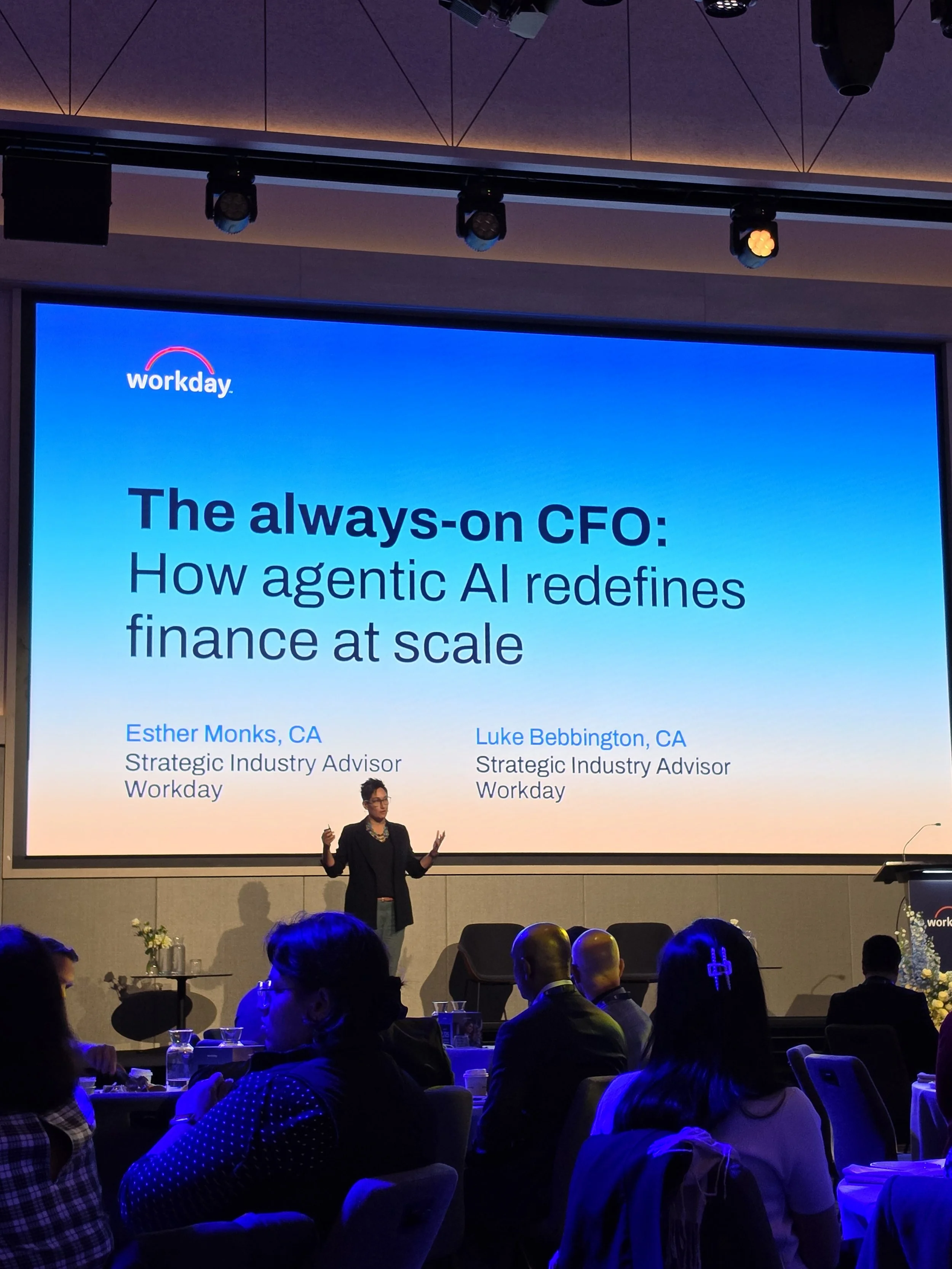
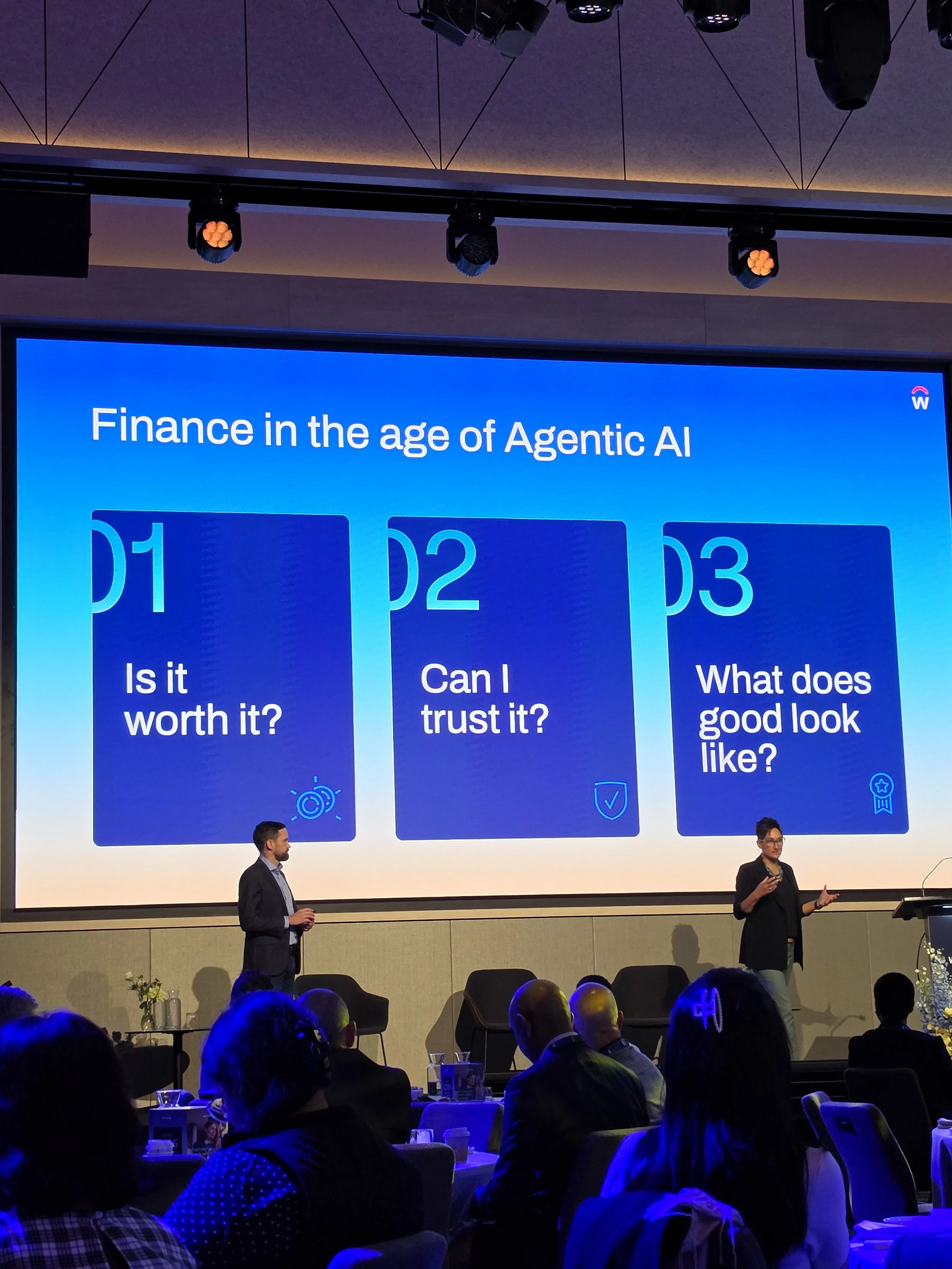
The role of finance isn't changing, but everything underneath it is. Workday's Esther and Luke Beddington (OCFO practice, APAC) built the session around three questions: is AI worth it, can I trust it, and what does good look like?
Is it worth it? Workday's ANZ research found 1 in 5 employees lose 7 hours a week acting as "human APIs" between systems. AI is clawing back time, but around 40% of the savings disappear into checking and rework, and only 14% of people consistently turn it into ROI.
Can I trust it? Luke told the story of Anthropic's experiment letting an AI run an office shop. The first attempt gave away discounts and sold stock below cost. A year later, with better models plus a ledger, an inventory system and procedures to follow, the losses largely disappeared. Anthropic's conclusion was that bureaucracy matters, which every finance professional already knew.
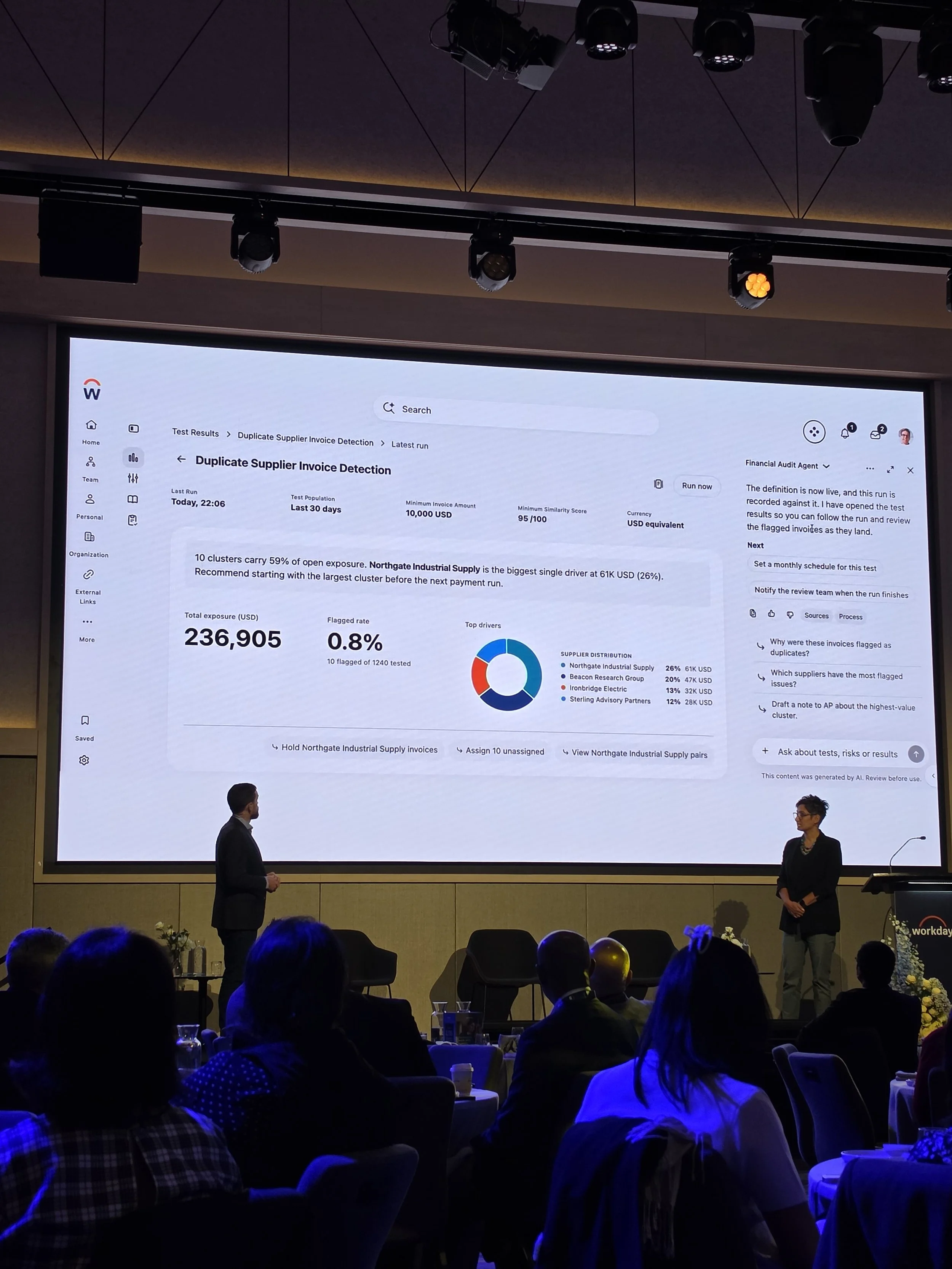
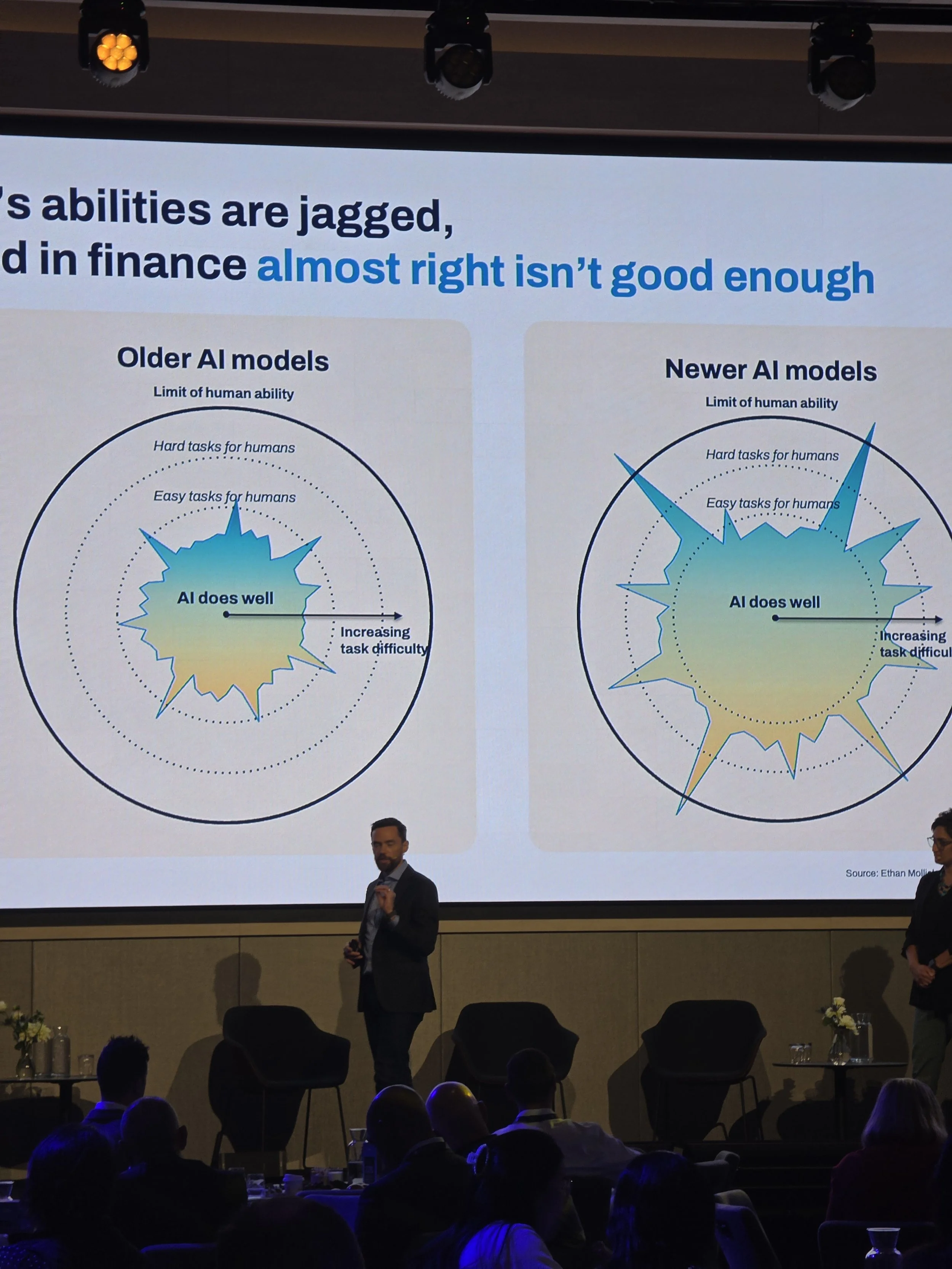
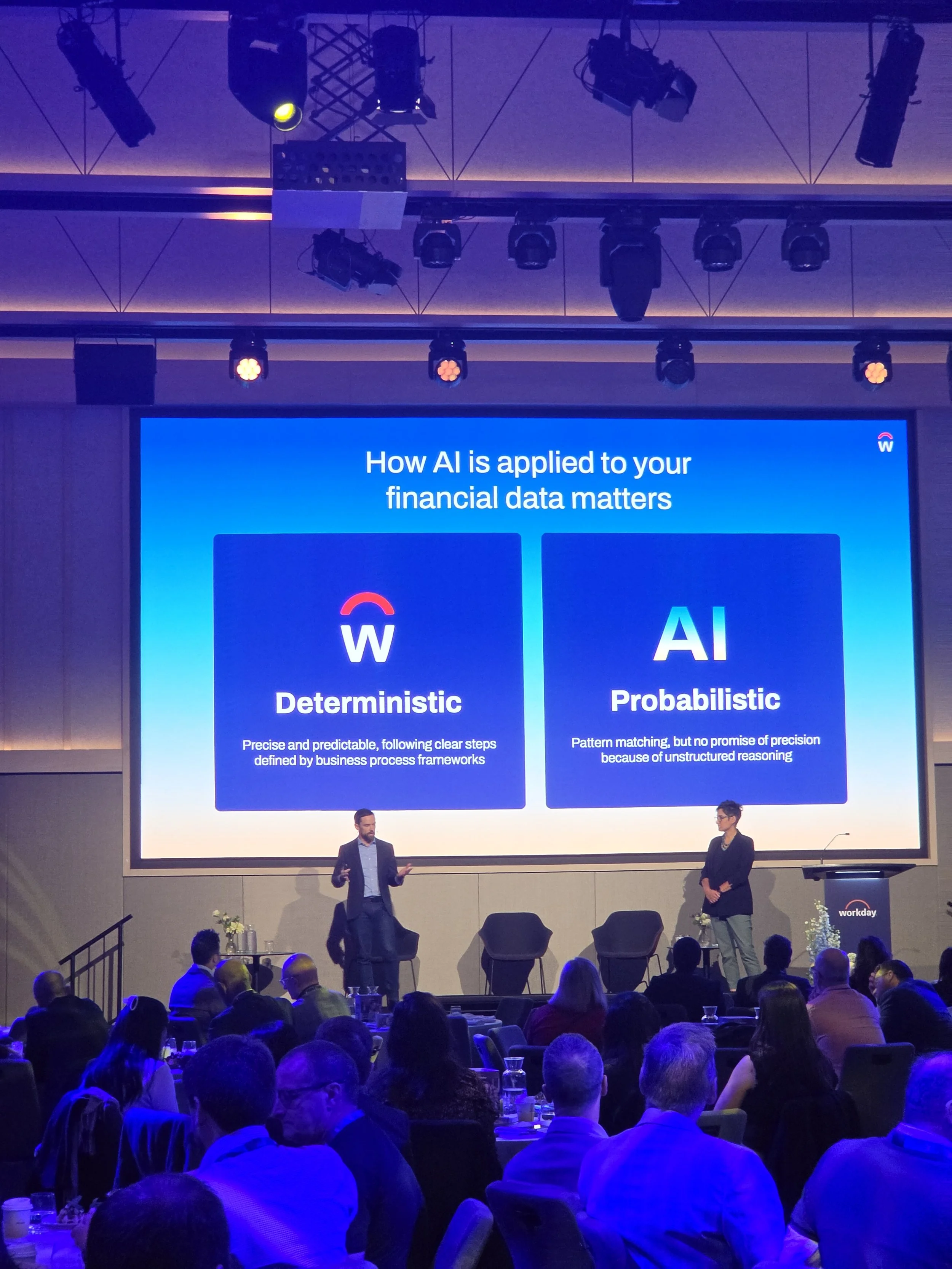
The finance translation: wrap deterministic processes around probabilistic AI. At 99% accuracy, 1,000 supplier invoices still means 10 wrong ones, and you don't know which. And because AI multiplies whatever data it sits on, messy data scales into messy answers.
What does good look like? Workday showed three pillars, all live with customers or early adopters:
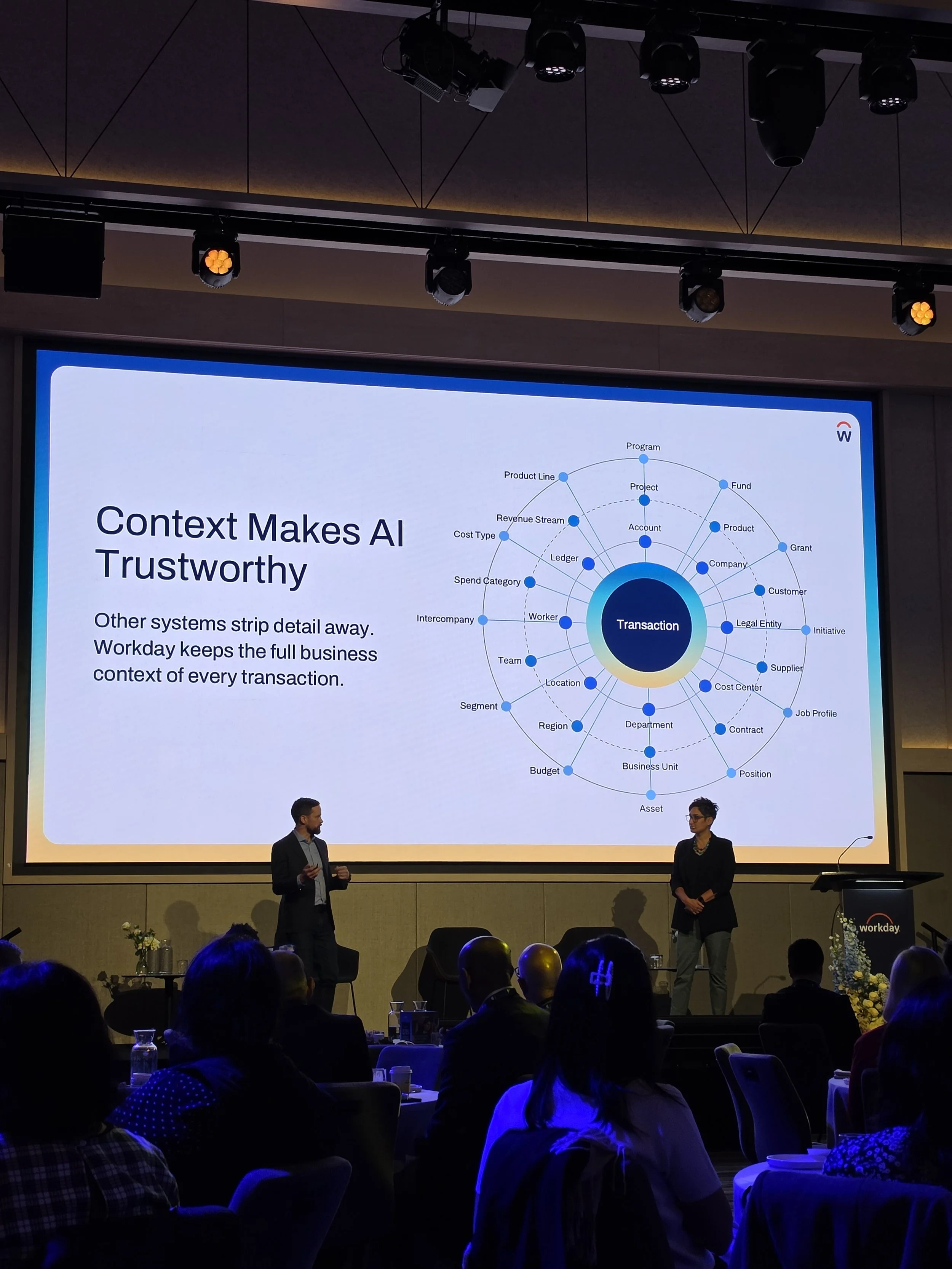
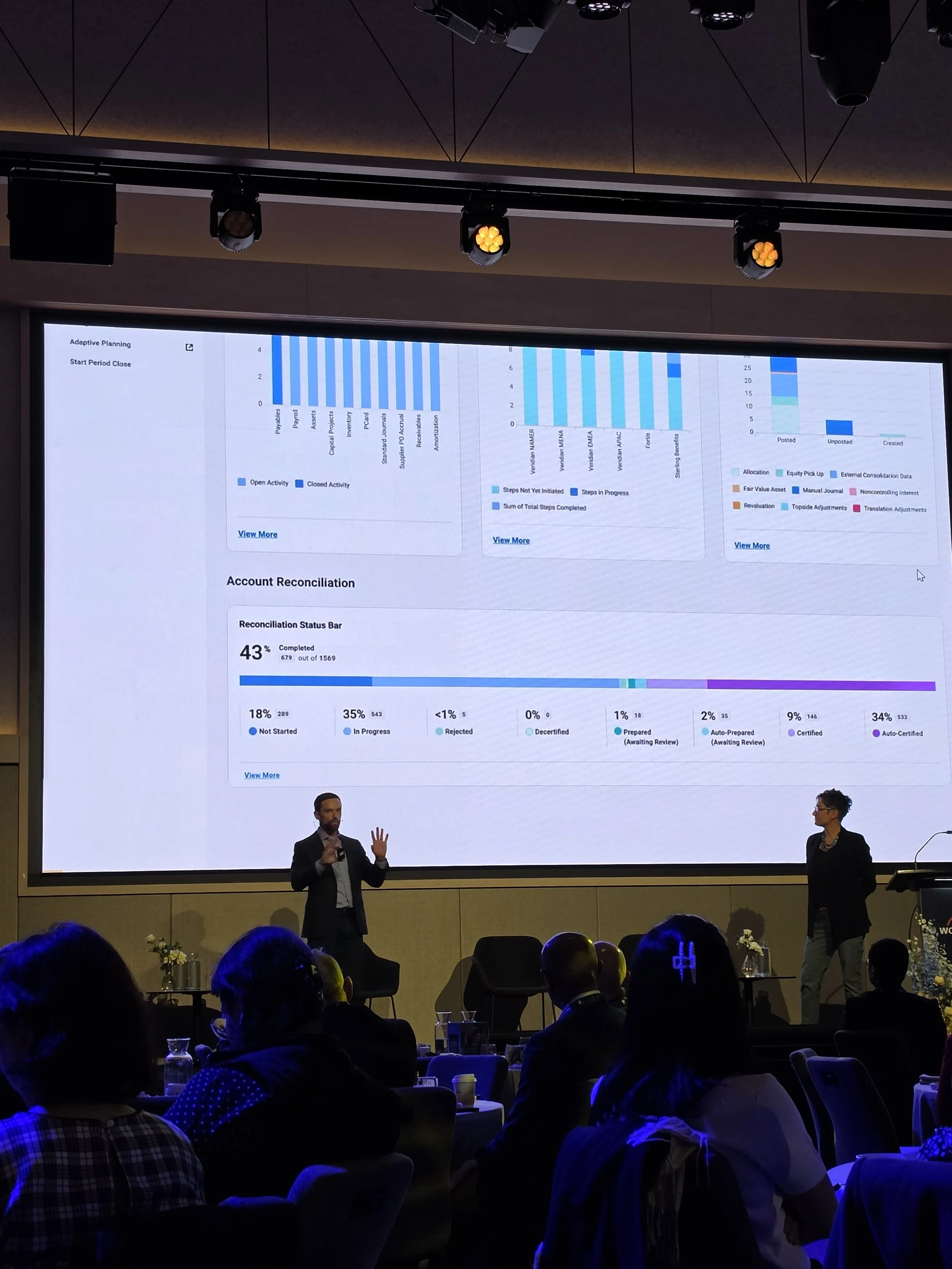
Trusted context: an accounting agent with a reconciliation hub that auto-prepares and auto-certifies reconciliations, and flags exceptions such as aged items.
Autonomous controls: always-on tests such as duplicate supplier invoice detection (the most-requested control globally) and one-click audit evidence packages. Partners will be able to build and share tests.
Always-on insight: Workday Decision Intelligence, which builds a board pack from a natural-language prompt on governed data and exports to Excel or PowerPoint.
Luke also flagged the rise of the agent system of record. Regulators are starting to expect a register of every AI agent, its risk assessment, its controls and its data access.
Our take: A governed model, role-based security and full audit trail are the procedures that make AI answers in FP&A trustworthy. You don't need to be on Workday Financials to get them: Adaptive connects to any ERP and data sources including HRIS, CRM, data lake, operational systems, many more.
Customer panel: MYOB and Tennis Australia
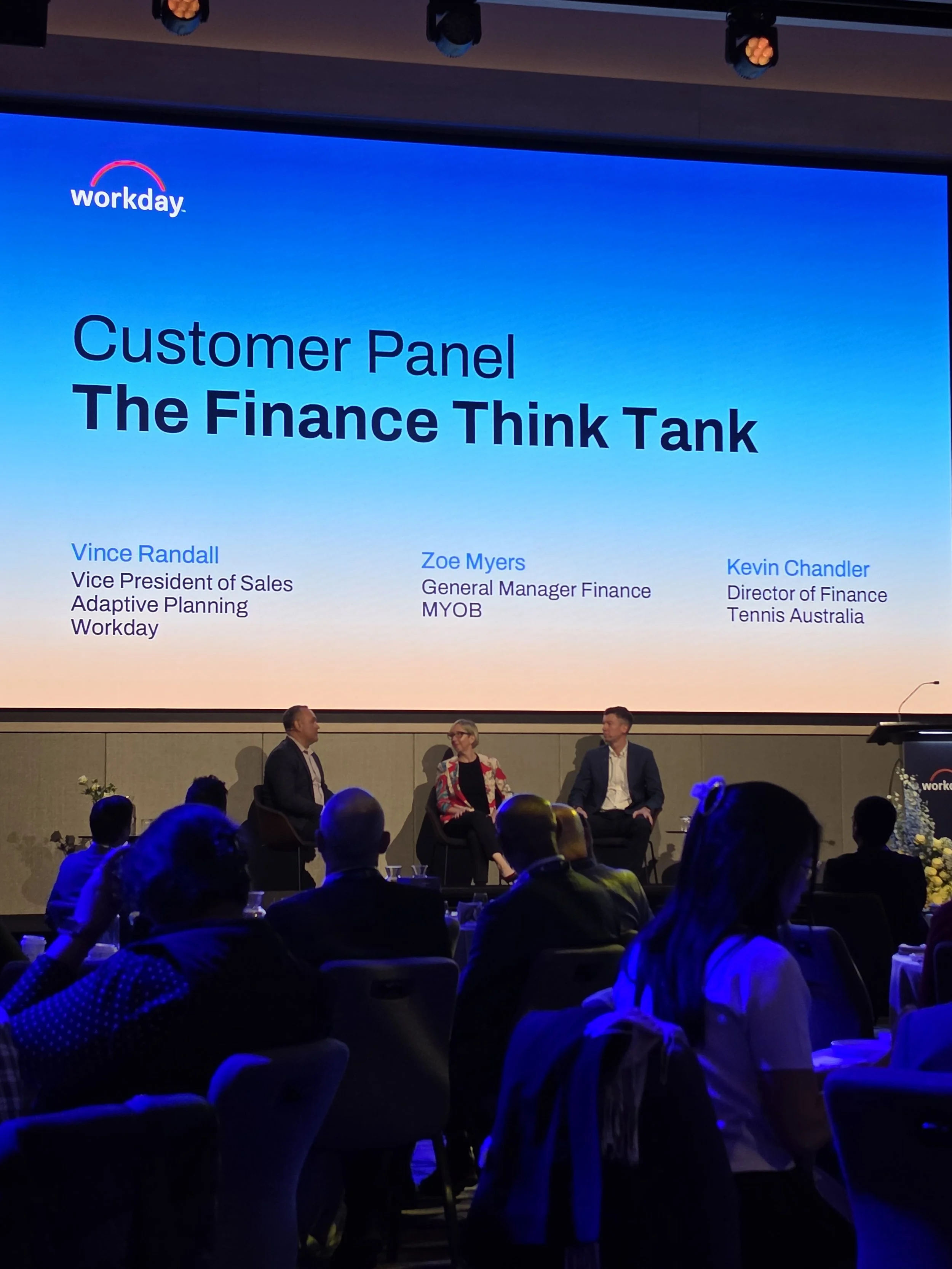
The customer panel showed two ends of the same curve: get the core right, then keep unlocking value. Vince Randall, who leads Adaptive Planning at Workday across APAC, hosted Zoe Myers (General Manager of Finance, MYOB) and Kevin Chandler (Director of Finance, Tennis Australia).
MYOB, one year in. MYOB moved off a legacy desktop system while also changing its CRM and billing. In year one it has:
brought an acquired business onto one system and integrated payroll
paid small-business suppliers 3.5 days faster
taken two weeks out of its first year-end audit
taken a day out of month-end close, with a clear path to a three-day close
used AI to draft notes to the financial statements with automatic tiebacks
used Prism to reconcile billing, revenue recognition and cash daily, across hundreds of thousands of customers
It's now using Workday Financials duplicate invoice detection and audit agent. Zoe's focus is "the thinking, not the doing": let the tools do the lifting and point people at the exceptions.
Tennis Australia, five-plus years in. With most of its revenue landing in the three weeks of the Australian Open, Tennis Australia, which runs Workday Financials and Adaptive Planning, lives on what-if scenarios. Kevin's approach for the next phase is to start with the decisions the business needs to make. From there he works back to the structures (cost centres, spend categories, event codes), then roles and security, then processes.
His advice: don't disappear into a black box for a year perfecting the chart of accounts. Get something good enough, use it, and let the tools show you where the data falls short.
What both agreed on:
Self-service now means conversation. People expect to ask questions the way they do in ChatGPT, and the answers are only as good as the structures behind them.
Curiosity is the skill to build. Kevin's line: as you move up, you don't get more answers, you get better questions. Zoe's team uses AI to rehearse, for example asking it to play a new board chair and predict the questions.
ROI isn't headcount. The goal is to be in the conversation earlier and bring insight to the table, not wait for questions.
Start somewhere. Commit to a starting point, then commit to iterating.
Our take: neither team got here overnight, and neither waited for perfect data. MYOB's quick wins came from fixing core processes first. Tennis Australia shows the payoff: years of clean structures in Workday and Adaptive now support what-if scenarios on the few weeks that make its year.
Kevin's point that you need the right source of truth for each question, not all your data in one place, is also how Adaptive works best. It pulls actuals, workforce and operational data from where they live into one governed plan - you do need to “sort out the data” before Adaptive, Adaptive is the tool that helps teams to sort it.
FP&A masterclass: Decision Intelligence in Adaptive Planning
The value isn't knowing you'll miss the number. It's knowing your options and their consequences while there's still time to act. That was Vince Randall's framing for the Adaptive Planning breakout.
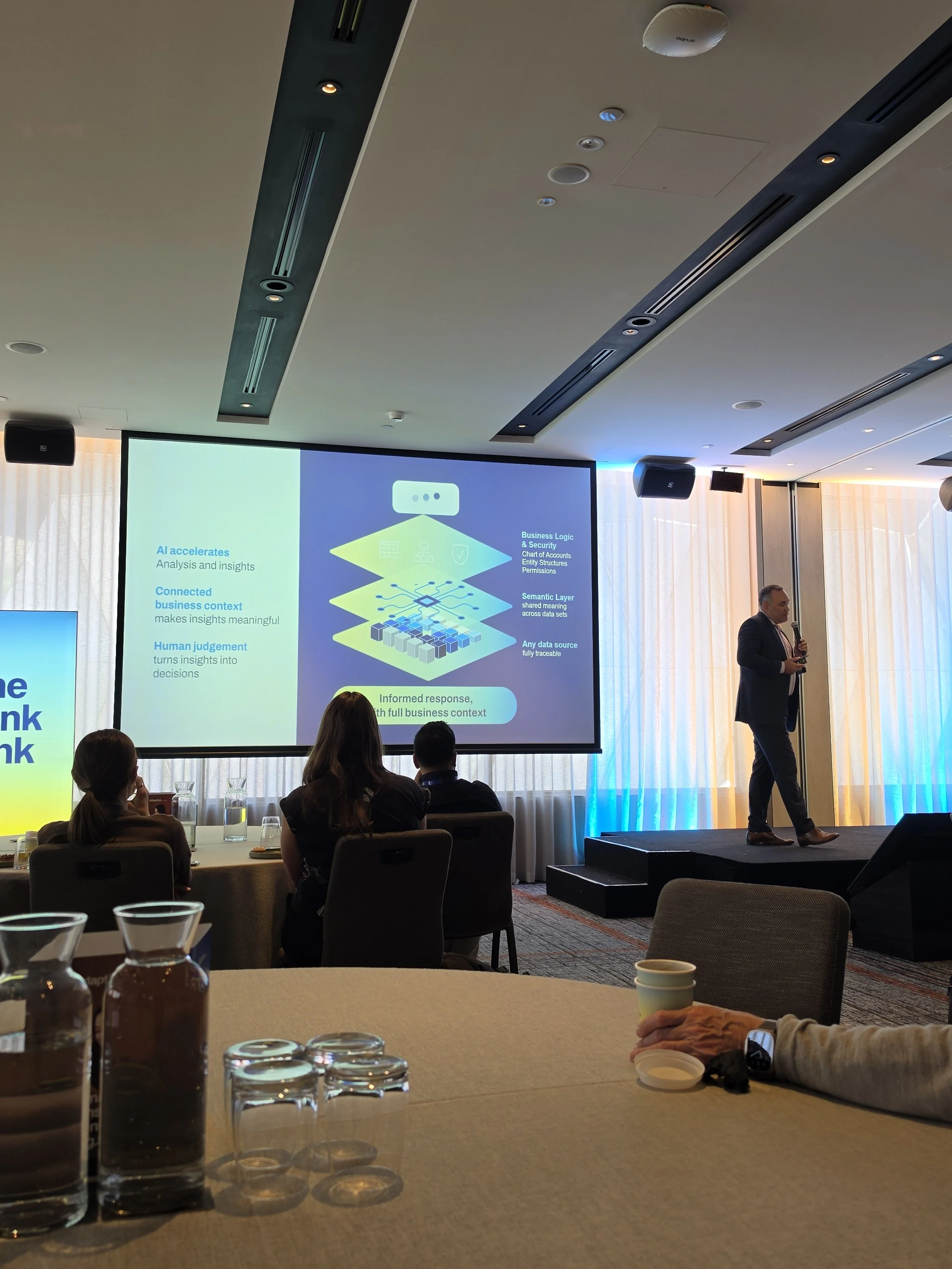
He also addressed the "we'll just run planning in ChatGPT" idea head on. A standalone LLM has no business context, no permissions, no shared definitions (the semantic layer) and no audit trail back to the data.
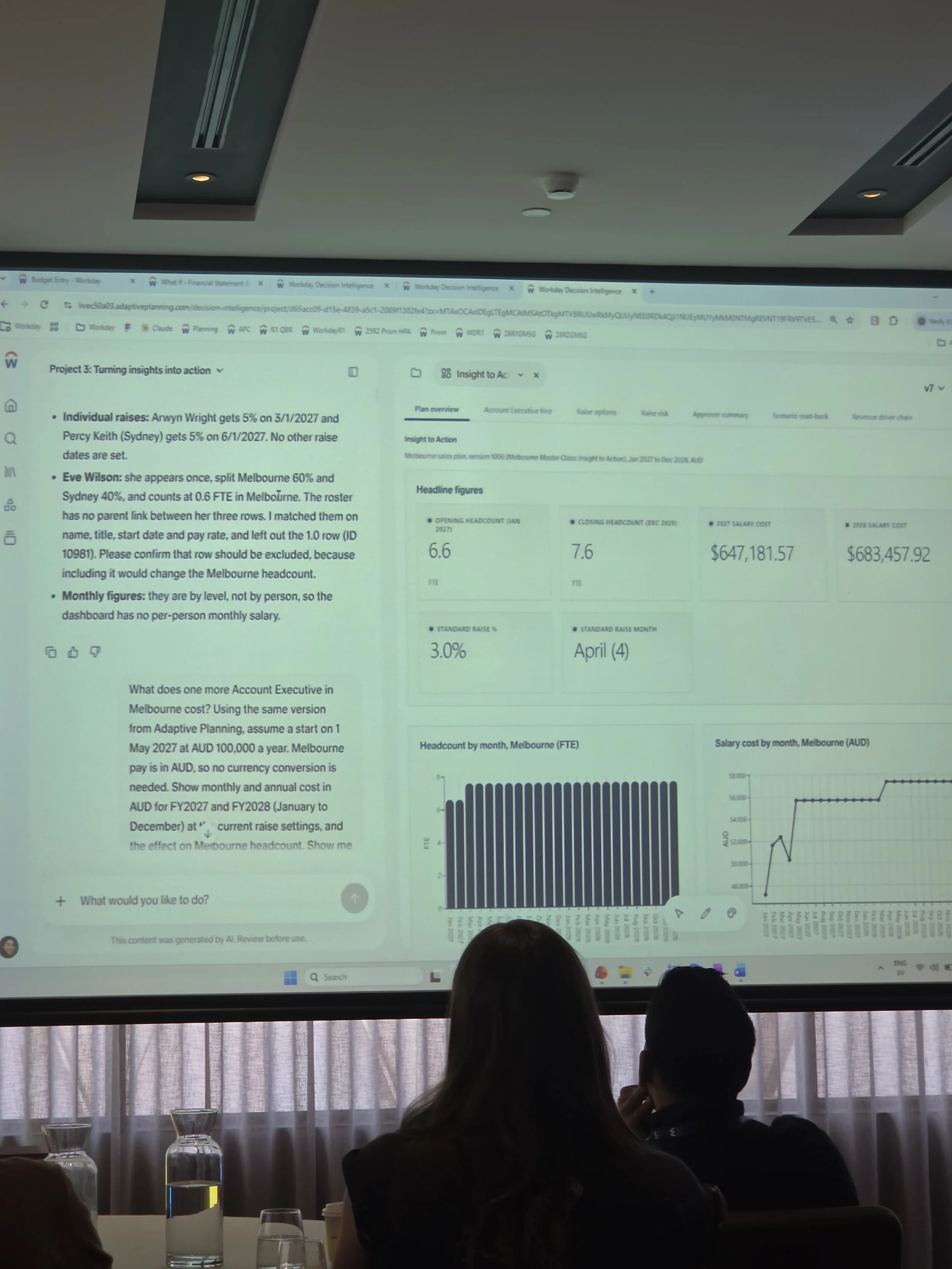
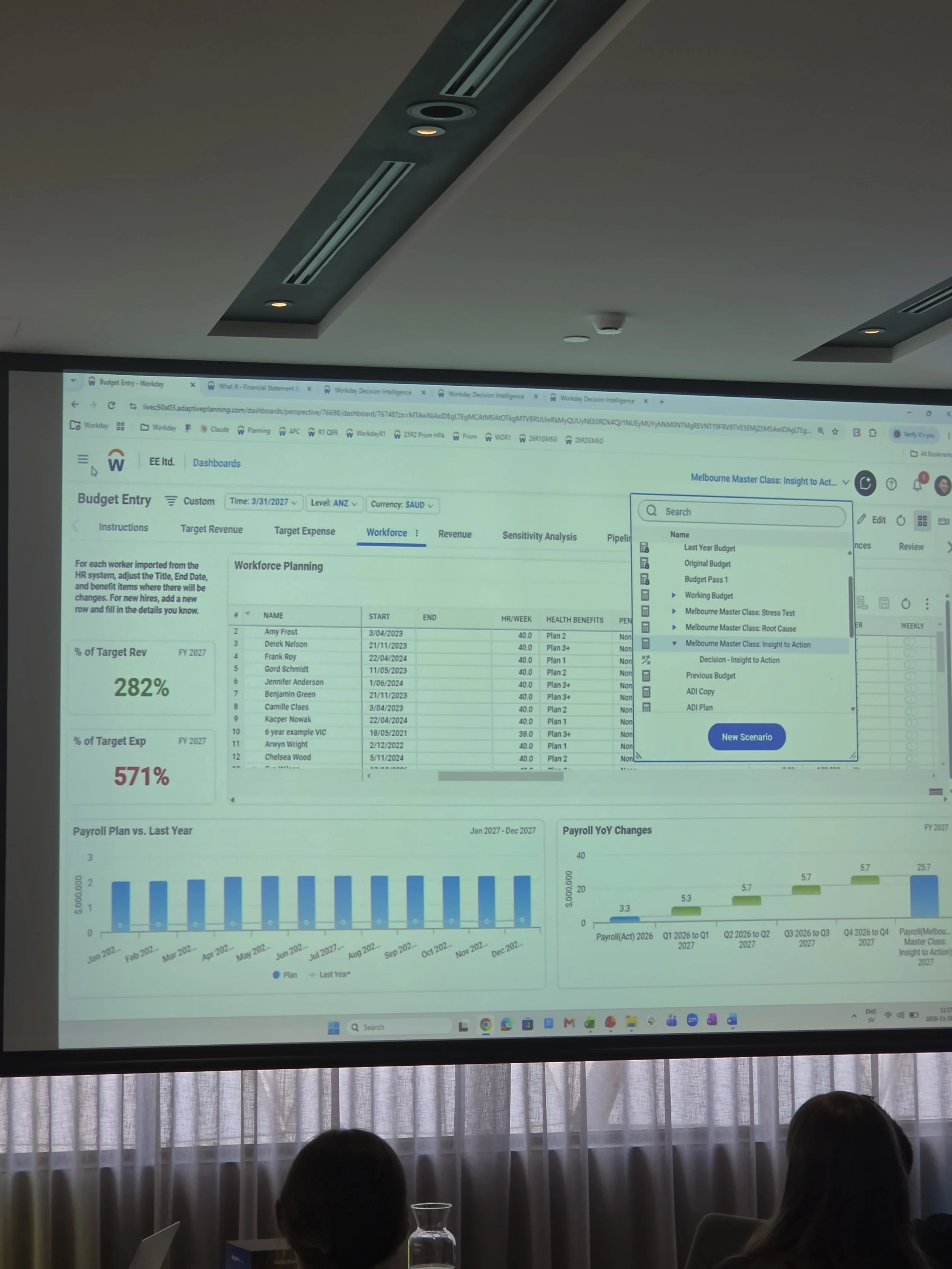
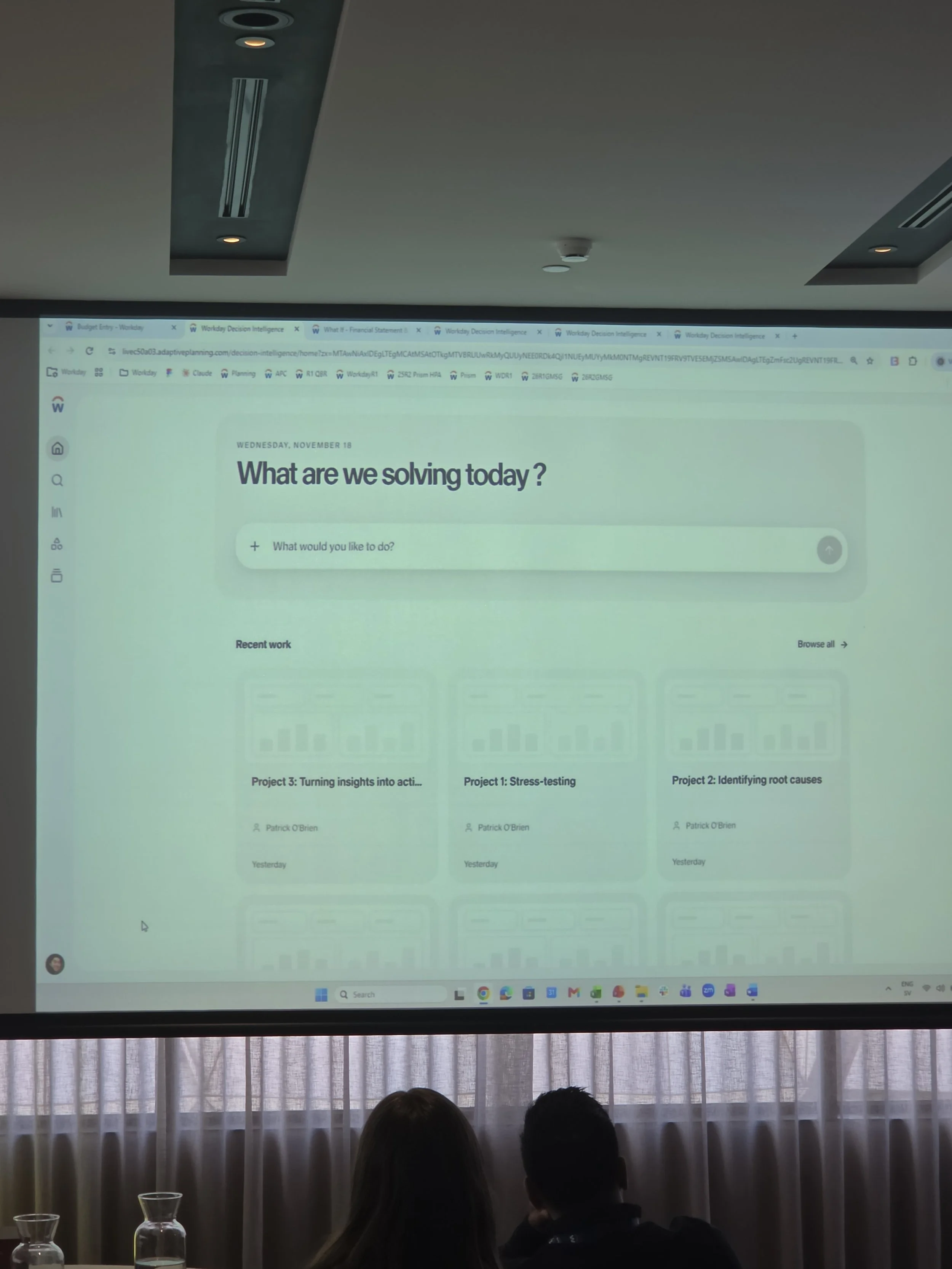
Workday's Eric then demoed Decision Intelligence, which sits inside Adaptive Planning. The room voted for the "turning insights into action" use case, and the flow went like this:
Ask in plain English. Pull the Melbourne plan data, in AUD. Results respect your security, so you only see what you're allowed to see.
Get a semantic model. It builds one on top of the governed Adaptive model, so every definition traces back to one source of truth.
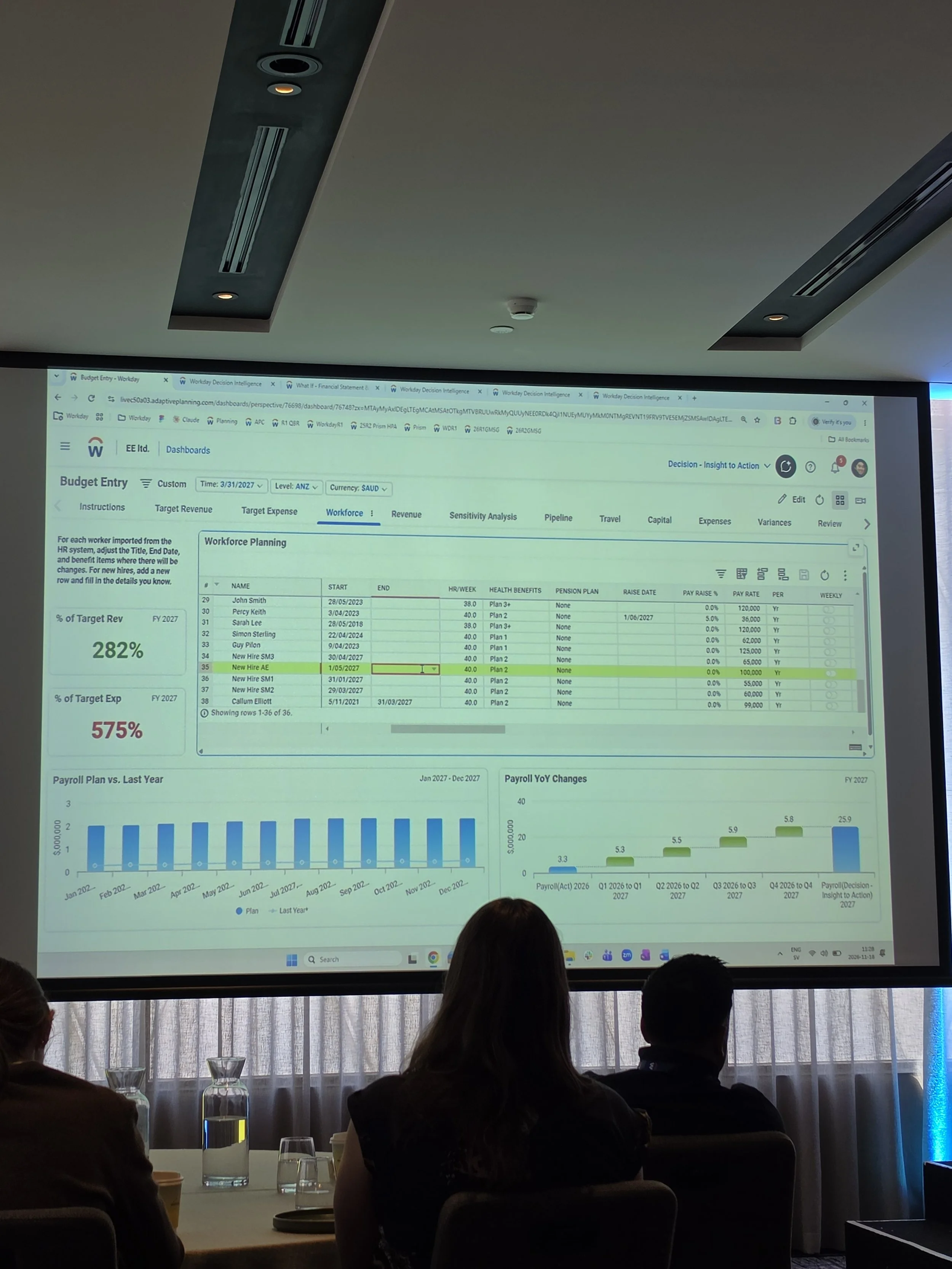
Model a decision. Add one account executive at $100k a year, then test different pay-rise timing options.
Quantify the risk. Run a 10,000-simulation Monte Carlo with P10, P50 and P90 outcomes and a tornado chart of the drivers. Every assumption is listed, so it's never a black box.
Act on it. Publish the chosen scenario straight back into the Adaptive model as a planning version, with the changes highlighted, then ask it to validate the result.
The best moment was what didn't happen: revenue didn't rise with the new hire. Asked why, Decision Intelligence followed the revenue driver chain and pointed to quota and market saturation. That's the conversation an FP&A partner should be having with sales.
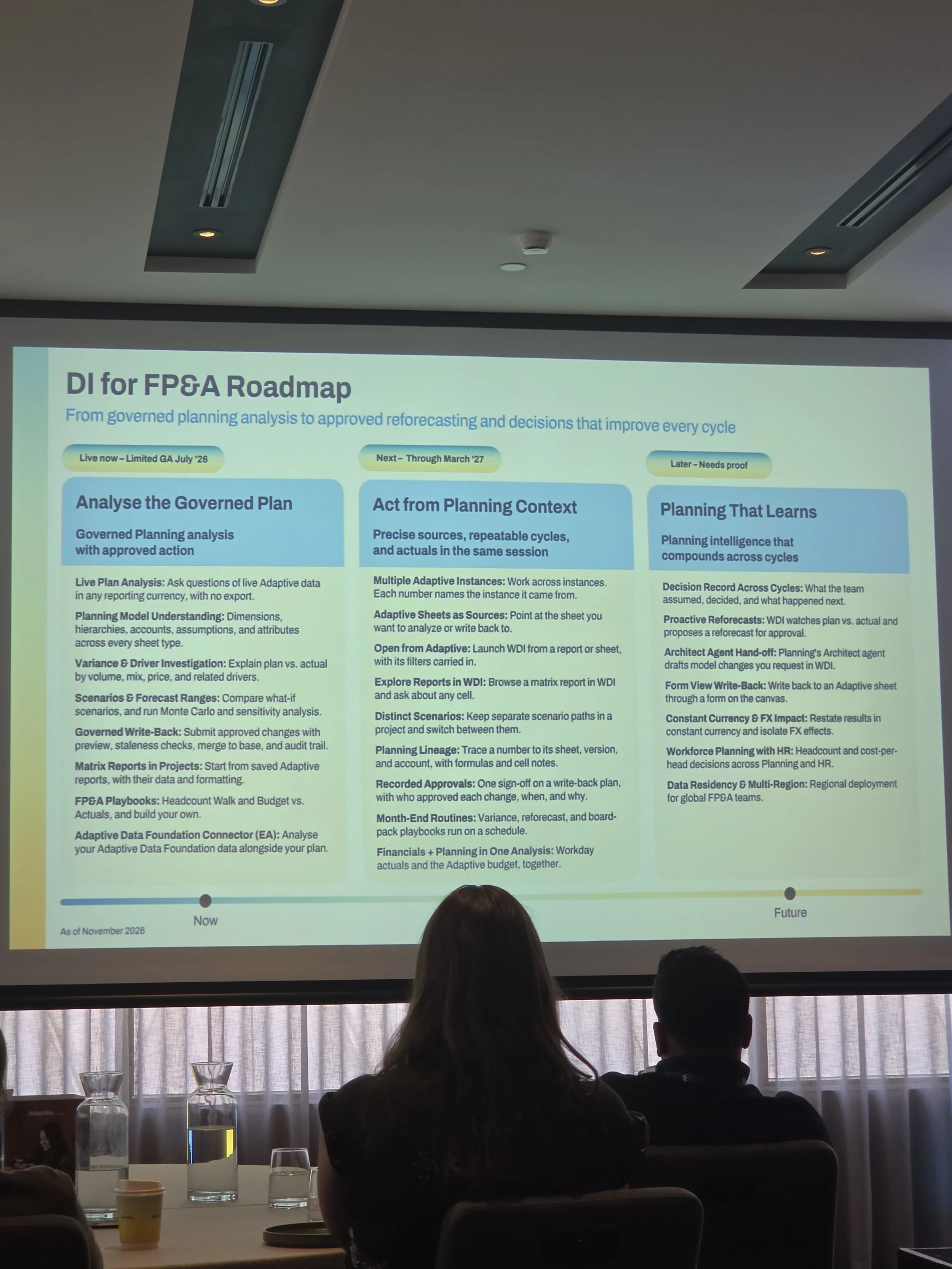
What's coming next, per Workday's roadmap: Decision Intelligence across multiple Adaptive instances, and a "decision memory" that records why you made each call and uses it in later analysis.
That's the real case for Adaptive. AI in a spreadsheet is still a spreadsheet: no permissions, no audit trail and plenty of key-person risk. A governed planning model gives AI the context it needs and lets the whole organisation plan in the same versions. It also records who changed what, and it stays with the business when people move on.
Our take: what this means for your FY28 budget
The FY28 budget cycle is the moment to get your planning foundations AI-ready. Here's what we'd take away from the day:
Your planning model is your AI's context. Clean drivers, consistent definitions and proper security are what make AI answers trustworthy.
Good enough beats perfect. Like MYOB and Tennis Australia, start with the decisions that matter most and iterate from there.
Put AI in the plan. Model AI costs and benefits as drivers, such as cost per outcome, so there are no $280k surprises.
Get more from what you already own. If you're already on Adaptive but still modelling in Excel, moving those models in is the fastest win. It's also the groundwork for Decision Intelligence.
If your plan lives in spreadsheets, your current EPM solution isn't serving your organisation, or you have Adaptive but the model hasn't kept up with the business, the FY28 budget is a natural point to fix the foundations. That's when AI in planning starts to pay off.
Let's talk.
Data Hive Consulting helps finance teams implement, optimise, and extend Adaptive from Workday and OneStream. Whether you're still in spreadsheets or want to get Decision Intelligence ready, we can help. Join over 7,000 teams globally, and 750+ in ANZ who have Adaptive in place and are ready to accelerate even faster with Decision Intelligence, planning at the speed of conversation.
Data Hive Consulting is an EPM consulting firm specialising in Adaptive from Workday and OneStream. We work with organisations across ANZ of all shapes and sizes to accelerate time to insights, ultimately helping organisations to meet and exceed expectations, reduce surprises, and helping executives and teams make confident decisions at speed to driving business value.
Frequently asked questions
What is EPM, and how is it different from ERP?
Enterprise performance management (EPM) software handles planning, budgeting, forecasting, consolidation and reporting. Your ERP records transactions; EPM turns that data, plus operational data, into plans, forecasts and board reporting.
Do we need to replace our ERP to implement EPM?
No. EPM platforms sit on top of the ERPs and source systems you already run. That's also why acquired businesses can be brought into planning and reporting without first migrating them onto your ERP.
Can our team still use Excel?
Yes. Both Adaptive and OneStream let people work in Excel, but the numbers stay linked to the platform. Anyone can drill back to the source, and permissions and audit trails still apply.
How long does implementation take?
With a phased approach, most organisations see initial value in 4 to 12 weeks, typically starting with the budget or the month-end close. Broader rollouts across workforce, sales or operational planning follow from there. Timelines depend on scope, data quality and the number of source systems.
What does an implementation involve?
Typically: design workshops to agree the model and reporting, connecting source systems, building and testing the model, loading history, training users and running a parallel cycle before go-live.
Who needs to be involved?
A finance lead who owns the model, someone from IT for system connections, and the department heads who will submit numbers. Executive sponsorship from the CFO matters most.
How do we know we've outgrown spreadsheets?
Common signs: the budget takes more than a few weeks, reconciling department inputs takes most of the cycle, nobody is sure which version is final, board packs are rebuilt by hand, or an acquisition makes consolidation painful.
Is AI included?
Yes. Both platforms build AI into planning and reporting, working on governed data rather than disconnected files. That means faster forecasting and variance analysis without losing auditability or trust in the number, or putting your data at risk.
Adaptive or OneStream: which is right for us?
Adaptive is strong for fast, flexible financial, workforce and operational planning. OneStream unifies financial close, consolidation, planning and reporting in one platform, which suits complex, multi-entity or acquisitive groups. The right choice depends on your priorities, complexity, and scale, and we can help you assess both.
Explore EPM solutions to get out of spreadsheets
Adaptive from Workday
Formerly Workday Adaptive Planning.
Adaptive overview: the unified planning platform
Financial Planning: budgeting, forecasting and reporting
Workforce Planning: headcount and people-cost planning
Operational Planning: plans modelled at the level teams work
AI for FP&A: AI built into the planning model
OneStream
OneStream platform: one platform for close, planning and reporting
AI Financial Planning: forecasting, scenario modelling and driver-based planning
Financial Close & Consolidation: consolidations, reconciliations and journal management
Integrated Business Planning: financial, sales, workforce and operational planning aligned
AI and Agentic Finance: governed AI agents for finance
Not sure which one fits your needs best?
Not sure which platform fits? Data Hive Consulting implements both and can help you assess where to start.
About Data Hive Consulting
Data Hive Consulting helps organisations transform financial reporting, budgeting, forecasting, consolidation and performance management through modern EPM solutions, including Adaptive from Workday and OneStream. We work with finance leaders across Australia and New Zealand to simplify processes, connect data, reduce spreadsheet dependency and improve decision-making.
Interested in what a platform-based, data-connected, governed driver-based planning model would look like for your business? Already have a platform which you would like reviewed, improved, or extended?
Get in touch to talk the art of the possible for your reporting, planning, and insight generation with EPM.
If you would like to get on the list for future events and updates, or want to speak about how Adaptive could work in your organisation, get in touch with our team.
Author: Leah Diprose - Commercial Director, Clients & Growth - Data Hive Consulting
